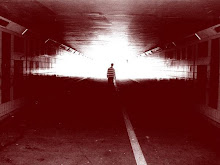
The pre-viz below shows roughly what my project consists of. However, I’ll definitely make major improvements to it as I go along.
Sunday, 14 March 2010

Monday, 8 March 2010
Major Project update
 Moving a statue in 12th Dynasty Egypt.
"Moving large stones over land was more involved. Sledges and rollers (the latter being of a more limited value) were available in pharaonic times, and workers were in great supply. Friction was the main obstacle. An 800 ton block measuring 4x4x20 m would create a ground pressure of 1 kg over each square centimeter of its base. A force of at least 400 tons would be required to overcome the friction. Modern engineers working under primitive conditions found that, while moving blocks weighing 6 tons on a sledge, friction could be reduced to nearly zero by wetting the track with a lubricant (in this case, water). In the relief pictured above, from the tomb of Djehutihotep, a man can be seen on the leading end of the sledge pouring a liquid on the ground in front of it. Modern reenactments also demonstrated that a friction "seal" is formed beneath a static load that is broken when the load begins to move. An Assyrian relief (below) shows the use of a lever at the back of the sledge, possibly used to break such a "seal," or perhaps to propel it forward." ( Larry Orcutt)

Moving a stone in Assyria.
"It has been estimated that a ratio of two men per ton would be required for moving loads over flat surfaces; nine men per ton would be required for moving loads up a 9° slope. Practical experiments moving loads on a sledge over a lubricated track have shown that one man could pull one ton. Thus, the 1,000 ton colossus of Ramesses II could have been moved by 1,000 men (or 200 oxen) "(Larry Orcutt)
"The movement of large stones was not confined to Egypt in ancient times. The Romans moved the so-called Trilithon, weighing 800 tons, from the quarry to the Temple of Jupiter at Baalbek (in eastern Lebanon) in the first century AD. Another stone weighing 1,200 tons, the Hajar el Hibla ("Stone of the Pregnant Woman"), was never separated from its base and lays abandoned. Though the Romans left no record of their methods, it is obvious that the Egyptians did not have a monopoly on any "secret" technique of moving large stones."(Larry Orcutt)
The "Stone of the Pregnant Woman,"
at the quarry near Baalbek.
at the quarry near Baalbek.

© Copyright Friedrich Ragette, Baalbek, p. 114
"It has been claimed by some that moving the largest of the Egyptian blocks would be beyond our modern-day technological capacity, even with the use of cranes and other heavy equipment. Such arguments are false. In 1999 it became necessary to move the 208-foot tall Cape Hatteras lighthouse to a location more than a half-mile away. The lighthouse weighs 4,830 tons and had to be moved in one piece in its upright position. How was this achieved?" (Larry Orcutt)

© Copyright U.S. Department of Transportation
"The use of cranes was impractical, and the actual technique used was very similar to that ascribed to the ancient Egyptians. First, the lighthouse was undercut and shored using timber (see photo below). One hundred hydraulic jacks were installed on rollers to slide along steel track beams placed beneath the lighthouse. A road was made by compacting the natural sands, overlaid with crushed stone, and finished with steel mats. Five hydraulic push jacks slowly shoved the lighthouse along the track beams in five-foot increments. The track was lubricated with soap shavings to reduce friction. The move, from start to finish, took 23 days." (Larry Orcutt)
The information provided by Larry Orcutt is a great help. Now I know that even back in the 12th dynasty, the Egyptians had a method for moving heavy objects over long distances. This means that the Pharaohs of the 21st dynasty, could have made use of the same method. The fact alone that a similar method was used even in the modern day to move the Cape Hatteras lighthouse shows that it’s very likely that the Pharaohs of the 21st dynasty could have had hundreds of men moving heavy objects on sledges over a slippery surface.
Wednesday, 3 March 2010
Major Project update
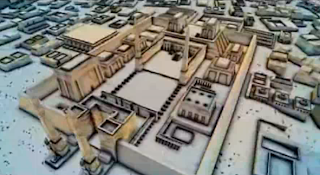
The pictures below come from a stylized animation that was part of a BBC documentary on Pi-Ramesse. The animation shows how Pi-Ramesse once looked like.




Tuesday, 2 March 2010
Major Project update
In my last tutorial I spoke to my tutor regarding what I could do in relation to Pi-Ramesse. The tutorial was very helpful to me. Thanks to my tutors suggestions I now know what I want to do. I'm aiming to produce a short version of the story of Pi- Ramesse, which could be seen as an education piece aimed at the ages 12 and up.
There will be three acts revealing the following information:
Act 1: The fact that Pi-Ramesse was found in Tanis caused a lot of confusion, since according to the ancient Egyptian documentation, it was not located there.
Act 2: The archaeologists figured out why the city was found in an unexpected place. It revealed that Pi-Ramesse’s original location was in modern day Qantir, but due to water problems it was moved to the modern day Tanis, some 200 years after the death of its creator; Ramesses the Great.
Act 3: The possible method used to move such an enormous capital over a distance of 30 km; from Qantir to Tanis.
Wednesday, 24 February 2010
Major Project update
I’ve noticed that the Mayan underworld idea was not getting me anywhere any time soon, so in my last tutorial with my tutor I decided to go for something with more potential. Since historical and archaeological documentaries interest me, my tutor recommended to me to watch a documentary titled ‘The Vanished Capital of the Pharaoh’ which could possibly help me to come up with something new.

The documentary was showing how an enormous Ancient Egyptian capital named Pi-Ramesse located at modern day Qantir disappeared. Ramesses the Great had moved the capital from Upper Egypt to the eastern delta, so that he could keep an eye on Egypt’s borders with modern day Turkey and Syria. It has also been said that he was trying to escape the influence of the Theban priests, as they seem to have been rather powerful at the time. Nevertheless, Ramesses the Great the ruler of the 19th dynasty had created an enormous city on the Nile, in order for his city to have no lack of water. The pharaoh named the city after himself, and many large statues (some 28 meters high) and other monuments dedicated to him were placed across Pi-Ramesse. The city also contained temples built to honour the Egyptian gods/goddess, in particular Amun. However, a long time after the death of Ramesses the Great, Pi-Ramesse mysteriously completely disappeared, as if it had never existed. In the 1920’s Pierre Monte one of Frances leading Egyptologists discovered in Tanis (deep in the Nile delta) something that seemed to him at first sight very promising. What he had found in Tanis was unbelievable; he had found the lost city of Pi-Ramesse. The cartouche of Ramsses the Great that could be clearly seen on the monuments that were half buried all over the site, convinced Monte within minutes that Pi-Ramesse lay right beneath his feet. Soon his team began to unearth the rest of the objects. They found temples dedicated to the god Amun, obelisks and colossal granite statues of Ramesses the Great weighing tons. Monte had no doubt that he had found Pi-Ramesse, even though for some strange reason particular parts of quite a lot of objects couldn’t be found at Tanis at all. In 1966 Manfred Bietak an Austrian archaeologist managed to figure out why the parts of those objects were missing. Bietak found out something very interesting; the objects found in Tanis where indeed those of Pi-Ramesse, but Tanis was not Pi-Ramesse. Soon Bietak teamed up with Edgar Pusch; a German archaeologist, to help him to find the original location of Pi-Ramesse. After quite a lot of work, they find the original location of the lost city at a town 30 km south of Tanis named Qantir. The foundations of the ancient capital were beneath Qantir, but what’s more important, they also find the missing parts of the objects situated at Tanis. Pi-Ramesse’s foundations were beneath Qantir, but its temples, statues obelisks etc where at Tanis, 30 km away from Qantir. It revealed that 200 hundred years after the death of Ramesses the Great, the river branch that had kept the city alive for years dried out, causing lack of water. The pharaohs of the 21st dynasty had no other choice but to move the capital to the next river branch that was located at Tanis. However, to many this made no sense. How could such an enormous city be moved over a distance of 30 km without the use of modern equipment? Many objects found at Tanis were indeed extremely heavy to move, even with the use of modern day equipment. Actually, there are ancient objects in Egypt that can’t even be moved by cranes. The fact that they didn’t have the equipment we have nowadays, but still managed to accomplish such impossible seemingly tasks, made a lot of people feel that this was beyond their normal understanding.
Subscribe to:
Posts (Atom)